
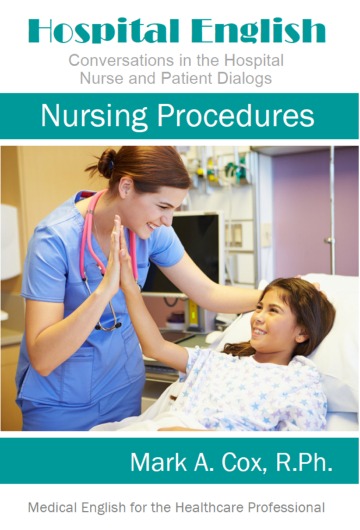
60 pages | 7 units | KDP Paperback
Hospital English: Nursing Procedures
Conversations in the Hospital — Nurse and Patient Dialogs
A practical English conversation textbook for nurses and nursing students. Seven units of realistic nurse-patient dialogs, structured vocabulary, language focus boxes, and pair-work speaking activities. Designed for intermediate learners with or without prior medical knowledge - and developed from 20+ years of teaching medical English at nursing colleges in Japan.
Each unit is built around a realistic nurse-patient scenario. Students work through vocabulary, a model dialog, language explanations, and pair-work activities until they can perform the procedure in English without the book.
In the Patient's Room
Greeting an admitted patient, escorting them to their room, explaining room items and hospital rules, and showing how to use the bed remote, call button, and other equipment.
Introduce yourself as the patient's nurse
Explain items in the patient's room
Explain hospital rules to the patient
Explain how to use various room items
In the Hospital
Asking about symptoms, responding to patient concerns, and orienting a patient to the hospital - explaining departments, floors, and what each unit does.
Ask the patient how they are feeling
Ask about and discuss symptoms
Explain where hospital units are located
Explain what each hospital department does
Getting a Patient's Information
Taking a full patient intake - name, date of birth, occupation, reason for visit, medical conditions, current medications, allergies, diet, substance use, and hygiene.
Gather a patient's personal information
Take a patient's medical history
Ask politely using set question frames
Name common medical conditions
Taking Vital Signs
Taking temperature, pulse, and blood pressure - announcing each step before doing it, reporting readings, using the future tense for procedures, and adding a personal touch.
Take vital signs using English instructions
Report vital sign values to the patient
Explain what you are going to do first
Have a natural, personal conversation
Taking a Blood Sample
Explaining the purpose of the blood draw, setting the tourniquet, disinfecting, taking the sample, and giving clear post-procedure instructions using "if" clauses.
Take a patient's blood sample in English
Explain what to watch out for afterward
Tell the patient what to do if problems arise
Explain why you are taking the sample
Giving Medication
Explaining a prescription - what the medication is, why the patient needs it, and how to take it. Covers prescription shorthand, medication types, side effects, and adverse reactions.
Explain what a medication is and what it is for
Explain how to take the medication
Discuss common side effects
Read and explain prescription shorthand
Administering Immunizations
Giving a flu shot - step-by-step administration dialog, post-vaccine instructions, common and serious reactions to watch for, and vaccine comparison table for flu, COVID-19, and Tdap.
Administer a vaccination in English
Explain side effects and post-vaccine care
Speak politely when giving instructions
Adapt the dialog for different vaccines
Every unit follows the same 8-part structure so students and teachers always know where they are and what comes next.
2-3 open questions to activate vocabulary and personal experience before reading. Done in pairs.
8-9 key words from the dialog. Students match words to English definitions, then review with the instructor.
A realistic, carefully paced conversation. Students listen, discuss, then practice in pairs until they can perform it without the book.
Key patterns, grammar points, and vocabulary specific to the unit - location language, future tense for procedures, "if" clauses, polite requests, and more.
Pair-work role plays, brainstorming tasks, and substitution drills that extend the model dialog into new situations.
Fill-in-the-blank exercises using the pre-reading vocabulary, often in a new medical context.
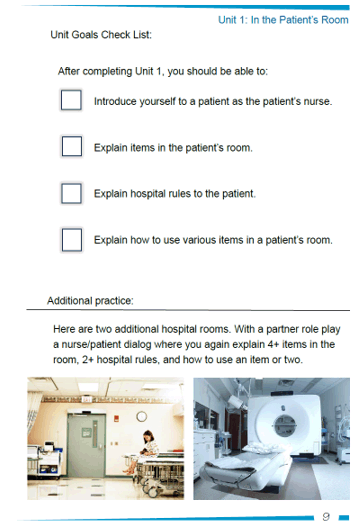
4 specific, checkable goals per unit. Students self-assess and return to any section they have not yet mastered.
Extended role-play suggestions, vocabulary quiz activities, and 5-sentence writing prompts using new words.
Click any page below for a closer look.
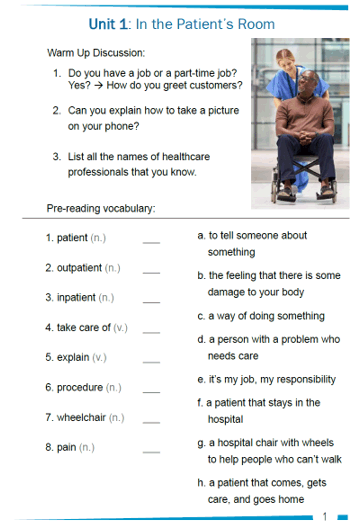
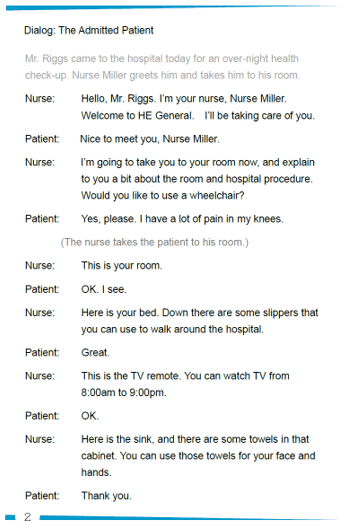
The procedure pages on Hospital English are designed to complement the textbook. Each page has audio vocabulary, an expanded dialog, language notes, speaking activities, and a printable worksheet - free for students and teachers.
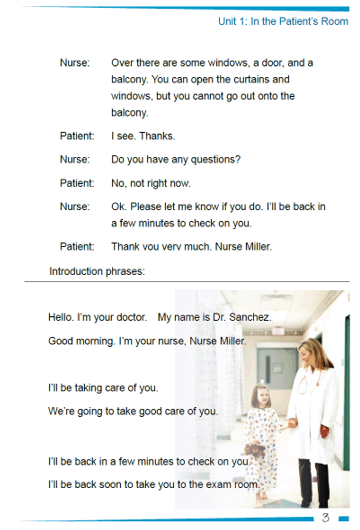
Greeting the Patient
Introduction phrases, room vocabulary, location language, and dialog practice for Unit 1.
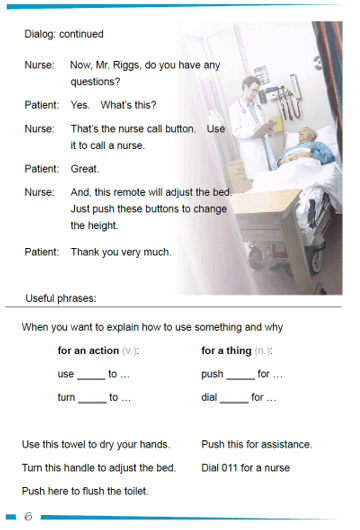
Open lesson ›In the Patient's Room
Hospital rules, room items, "you can / you may" patterns. Extends Unit 1 further.
Open lesson ›Explaining the Hospital
Department vocabulary, floor plans, and asking about symptoms. Companion to Unit 2.
Open lesson ›Getting Patient Information
Polite question frames, medical history form, allergy and diet questions for Unit 3.
Open lesson ›Taking Blood Pressure
Vital signs vocabulary, medical readings, future tense for procedures. Companion to Unit 4.
Open lesson ›Taking a Blood Sample
Tourniquet, disinfecting, "if" clauses for patient instructions. Companion to Unit 5.
Open lesson ›Giving Medication
Medication types, prescription shorthand, side effects, adverse reactions for Unit 6.
Open lesson ›Giving a Shot
Vaccination dialog, post-vaccine instructions, and comparing flu, COVID, and Tdap. Unit 7.
Open lesson ›All procedure pages include click-to-hear vocabulary, printable worksheets, and a collapsible teacher lesson plan.
Supplementary materials for classroom and self-study use - additional vocabulary exercises, audio, and more at HospitalEnglish.com.
Mark A. Cox, R.Ph., MAAL is a US-licensed pharmacist (University of Connecticut School of Pharmacy, 1997) with hospital experience at Yale New Haven Medical Center and Hartford Hospital. He has lived in Japan since 2000 and has been teaching English as a foreign language since then. Since 2005 he has taught medical English at nursing technical colleges, and since 2009 at a nursing university in Nagano. He holds a Master of Arts in Applied Linguistics from the University of New England, Australia (2010).
The content for this textbook was written for - and used for over 20 years with - his nursing college students before being published. His free teaching resources are available at MES-English.com, ToolsForEducators.com, and MES-Games.com, among others.
